
If you’re a business owner, startup founder, or someone with a brilliant idea, there’s one big question you must face: What is the best technology to develop mobile applications?
Think about the last time you ordered food, booked a ride, or even meditated — chances are, you did it using a mobile app. Today, mobile applications are not just a trend but a way of life. With over 257 billion app downloads globally in 2023 (Statista), it’s clear that mobile apps power the digital economy.
In this blog, we’ll go through everything you need to know to choose the best technology for mobile app development in 2025. Whether you’re a small business owner, startup founder, or someone just curious about the tech behind the apps, this guide is written with simplicity, clarity, and practicality in mind.
Table of Contents
- Native vs Cross-Platform Development: Which Path Should You Take?
- Best Native Technologies in 2025
- Best Cross-Platform Technologies in 2025
- Emerging Technologies in Mobile Applications
- Backend and Supporting Tech Stack
- Key Factors to Consider Before Choosing a Tech Stack
- Our Recommendation: The YeasiTech Approach
- Conclusion: Let’s Build Something Awesome Together
- FAQS
Native vs Cross-Platform Development: Which Path Should You Take?
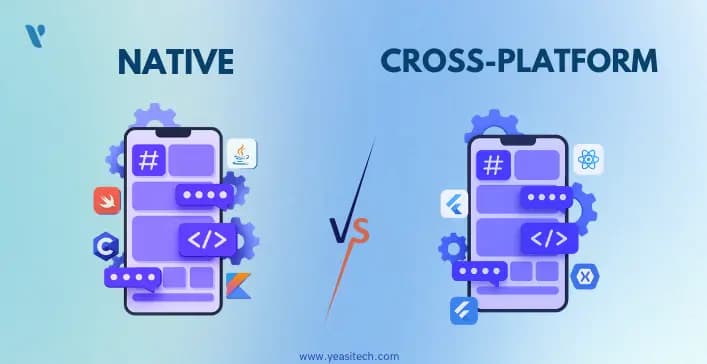
When it comes to mobile app development, you’ve got two main roads:
Native Development
Native apps are built specifically for one operating system — either iOS (Apple) or Android (Google). They are like tailor-made suits: designed to perfectly fit one platform.
- iOS apps are written in Swift or Objective-C
- Android apps are written in Kotlin or Java
Cross-Platform Development
Writing a single codebase that runs on both iOS and Android is known as cross-platform. It’s similar to writing a single letter that both Google and Apple, friends, can understand. Popular cross-platform frameworks include:
- React Native
- Flutter
- Xamarin
As of 2025, Statista reports Flutter as the preferred cross‑platform framework at 42%, with React Native close behind at 38%
Best Native Technologies in 2025
If you want top-tier quality and performance in mobile applications, these are the go-to native technologies:
Kotlin (Android)
Kotlin has officially replaced Java as the preferred language for Android. It’s modern, safer, and far more readable.
Why Kotlin?
- Concise and expressive
- Safer code with fewer bugs
- Interoperable with Java (legacy code can still work)
Swift (iOS)
Swift is Apple’s powerful and intuitive programming language. It’s designed for performance and safety.
Why Swift?
- Fast execution
- Less error-prone
- Native Apple support
Swift is the future of Apple development.” – Tim Cook, CEO of Apple
When to Choose Native
- If you need the absolute best performance (e.g., Gaming apps)
- If your app relies heavily on device features (e.g., AR, Sensors, Bluetooth)
- If you want the best UI/UX
Best Cross-Platform Technologies in 2025
Cross-platform is perfect for startups, MVPs, and mobile applications that don’t need extreme hardware control
Flutter (by Google)
Flutter is a powerful UI toolkit that uses the Dart language. It lets you build natively compiled apps for mobile, web, and desktop — from a single codebase.
Pros:
- Beautiful UI
- Blazing-fast performance
- Strong community and support from Google
“Flutter isn’t just a framework; it’s an ecosystem.” – Tim Sneath, Product Manager at Google
Stat to Know: In a 2024 developer survey by Statista, 42% of developers chose Flutter as their preferred cross-platform framework.
React Native (by Meta)
React Native uses JavaScript and React to build mobile applications. It’s known for its fast development cycle and huge community.
Pros:
- Great for MVPs
- Reuse components and code
- Easier to find developers
When to Choose Cross-Platform
- If you have limited time or budget
- If you’re launching an MVP
- If your app doesn’t need deep hardware integration
Other Notables
- Xamarin (by Microsoft): Great for C# developers
- Ionic: Ideal for hybrid web-mobile apps
Emerging Technologies in Mobile Applications
Mobile app development is constantly evolving. Here are some cutting-edge technologies shaping the future:
1. Kotlin Multi-platform
- Allows sharing code between Android, iOS, backend, and web
- Native performance with cross-platform convenience
2. AI/ML Integration
- Libraries like TensorFlow Lite and CoreML are powering smarter apps
- Think: personalised recommendations, image recognition, and voice commands
3. Low-code/No-code Platforms
- Tools like OutSystems, Appgyver, and Glide are letting non-developers build basic apps
Low-code is no longer just a trend. It’s a movement.” – Forrester Research
4. Modular Architecture
- Separating an app into smaller, manageable modules = faster builds + easier testing
5. Progressive Web Apps (PWA)
PWAs blend web and app experiences. They’re fast, work offline, and are perfect for businesses that want a web-first presence.
6. Rust and Dart Gaining Ground
Languages like Rust (for performance) and Dart (used in Flutter) are becoming developer favorites for scalable, modern apps.
Backend and Supporting Tech Stack
Great mobile applications don’t just look good—they run smoothly thanks to a powerful backend. Here’s what’s under the hood:
1. Backend Frameworks
- Node.js – Fast, JavaScript-based
- Django – Python-powered, secure and clean
- Firebase – Google’s all-in-one mobile backend (popular for MVPs)
2. Databases
- PostgreSQL – Powerful and reliable
- MongoDB – Flexible NoSQL option
- SQLite – Great for offline apps
3. Cloud Hosting & DevOps
- AWS, Google Cloud, Azure
- CI/CD tools like GitHub Actions, Bitrise
4. APIs & Integrations
- Payment: Stripe, Razorpay
- Analytics: Firebase, Mixpanel
- Notifications: OneSignal, Firebase Cloud Messaging
5. Security & Analytics
- OAuth 2.0, JWT for user authentication
- Google Analytics, Mixpanel, and Firebase Analytics for user tracking
Tip: Don’t forget to budget for backend maintenance and cloud costs — especially as your user base grows.
Key Factors to Consider Before Choosing a Tech Stack
Still unsure which tech is best for your mobile applications? Here are the main questions you need to answer:
Cross-platform = Budget-friendlyWhat’s your timeline?Short time = Cross-platform or low-code
Long-term product = Native or hybridHow complex is your app?Simple apps (MVP, directory, store): Cross-platform
Complex apps (games, AR/VR, sensors): NativeDo you have an in-house team or outsourcing?Hard to hire Swift/Kotlin devs? Go with React Native or FlutterUser Experience priorities?Native always wins in performance and UXScalability needs?Plan backend tech early for growth
Our Recommendation: The YeasiTech Approach
At YeasiTech, we work with startups and businesses to choose the best mobile app development technology based on your goals, your users, and your budget, not just trends.
What We Recommend:
- For high-performance apps:
Go native with Swift (iOS) + Kotlin (Android).
Best when you need top speed, battery optimization, or deep hardware access.
Example: high-end games, intensive AR/VR, or camera-heavy apps. - For startups & MVPs:
Use Flutter or React Native.
It’s visually stunning, quick to build, and budget-friendly.
Great for testing ideas fast without sacrificing polish.
Example: marketplace app, social networking prototype. - For AI-heavy apps:
Combine native or Flutter with TensorFlow Lite.
We also help you scale from MVP to full product and integrate the right analytics, payment gateways, third-party APIs, and more.
“We don’t just write code — we build experiences that users love.” – Team YeasiTech
Conclusion: Let’s Build Something Awesome Together
Choosing the best technology for your mobile app isn’t just a technical decision — it’s a business decision. Whether you go native, cross-platform, or explore low-code tools, your choice should align with your goals, users, and growth plans.
Remember:
- Native = Speed and performance
- Cross-platform = Fast, affordable, and flexible
- Emerging tech = Future-ready innovations
The good news? You don’t have to figure it out alone.
Let YeasiTech Be Your Tech Partner
At YeasiTech, we help founders, startups, and businesses make the right tech decisions and turn their ideas into stunning, scalable apps. From strategy to development and post-launch support — we’ve got your back.
Ready to start? Let’s chat about your app idea — no tech jargon, just real results.

FAQS
1. What are the best technologies for mobile application development in 2025?
The best technology depends on your goals. For performance, go with native tools like Swift (iOS) and Kotlin (Android). For speed and flexibility, Flutter is a top cross-platform choice in 2025.
2. What’s the difference between native and cross-platform development?
Native development builds separate apps for iOS and Android using platform-specific languages, while cross-platform uses a single codebase to run on both.
3. Is Flutter better than React Native in 2025?
Yes, in 2025, Flutter often leads with better performance, UI consistency, and developer support. However, React Native still has a strong ecosystem.
4. Which backend technologies are best for mobile applications?
Popular backend choices include Node.js, Firebase, Django, and Laravel, depending on your app’s complexity, scalability, and real-time needs.
5. What factors should I consider when choosing a mobile application tech stack?
Consider app type, performance needs, development budget, time-to-market, scalability, and developer availability when selecting your tech stack.
6. Can I switch technologies after launching mobile applications?
It’s possible but costly. Migrating tech stacks post-launch requires major redevelopment, so it’s best to choose the right technology from the start.