
You’ve probably had this idea swirling around in your head:
“What if I launch a Web App like Vistaprint where people can customize products online, things like business cards, T-shirts, mugs, or invitations, and I fulfill the orders behind the scenes?”
Smart thinking! Custom product platforms are booming in 2026. People love being able to personalize things with just a few clicks.
But the big question most entrepreneurs get stuck on is:
“How much does it really cost to build something like that?”
If you’ve never built a website before (or have no idea what a backend is), don’t worry. We’ve written this blog for founders and entrepreneurs just like you. Let’s break it all down; costs, timelines, tips, and how YeasiTech can help you launch your platform with confidence.
Table of Contents
- What exactly is an app like Vistaprint?
- Real-World Stats & Insights (2026 Edition)
- Real Cost to Build a Webapp Like Vistaprint in 2026
- What Impacts the Cost of a Vistaprint-Like Webapp?
- How to Build a Webapp Like Vistaprint?
- How YeasiTech Helps You Build Smart & Spend Less?
- Actionable Tips to Keep Your Costs in Check
- Final Thoughts
- FAQs
What exactly is an app like Vistaprint?
Before we discuss figures, let’s define what a web app like Vistaprint is. Basically, it’s an e-commerce platform with an integrated design editor. The user has the ability to:
- Select a product (such as a flyer, mug, or t-shirt)
- Use templates, texts, and logos to create their own design
- Preview it in real-time
- Place an order
- Track delivery
Now, behind the scenes, that means this app needs:
Sounds complex? It is. But totally doable.
Real-World Stats & Insights (2026 Edition)
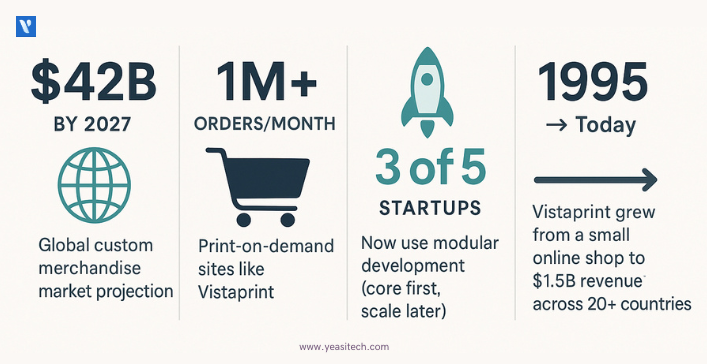
- The global custom merchandise market is projected to hit $42 billion by 2027.
- Print-on-demand websites like Vistaprint see over 1 million orders per month.
- In 2025, 3 out of 5 startups now opt for modular development — building the core first and scaling later.
Fun fact: Vistaprint began in 1995 as a small online print shop. Today, it operates in over 20 countries and pulls in $1.5 billion+ in annual revenue.
Real Cost to Build a Webapp Like Vistaprint in 2026
Here’s a realistic price range based on industry trends and the work we do at YeasiTech:
What Impacts the Cost of a Vistaprint-Like Webapp?
Here are the major cost drivers you need to know:
1. The Design Editor
This is the most expensive part. A real-time, drag-and-drop editor like Vistaprint’s can cost $ 10,000–$ 30,000 alone. If you want layers, font choices, image uploads, and product previews, the cost goes up.
2. Integrations
Want to connect with printing partners? Shipping APIs? CRMs like HubSpot? Payment gateways like Stripe or Razorpay? Every integration adds $2K–$10K.
3. Mobile Optimization
In 2025, 60%+ users are shopping from mobile. A responsive app is a must, not a luxury. Budget $5K–$15K for top-tier mobile UX.
4. Performance & Hosting
You’ll need solid hosting, fast loading speeds, and cloud storage. Depending on traffic, plan $10–$50/month for cloud infrastructure.
5. Security
You’re handling user data, designs, and payments. SSL, firewalls, encryption, and GDPR compliance are essential. Budget will be within $2K–$8K.
6. Development Team
Rates vary wildly:
- US/UK developers: $50–$100/hour
- Indian/Eastern European devs: $10–$50/hour
For cost-effective quality, companies like YeasiTech offer full-stack solutions at 40–50% lower costs — without compromising quality.
How to Build a Webapp Like Vistaprint?
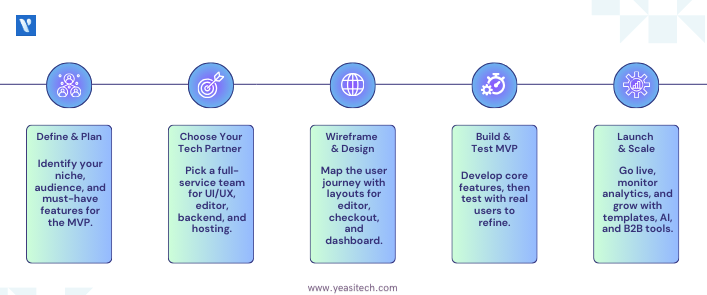
Here’s a simple 7-step roadmap you can follow to bring your vision to life, even if you’re not a tech expert:
Step 1: Define Your Niche and Audience
Ask yourself:
- What kind of products will users customize? (T-shirts? Business cards? Gifts?)
- Are you targeting businesses, individuals, or both?
- What makes your platform different from existing ones like Vistaprint?
Example: “We help local artists print their designs on eco-friendly notebooks.”
Step 2: Create a Feature Wishlist
Make a list of “must-have” and “nice-to-have” features.
Must-Have Examples:
- Product catalog
- Custom design editor
- Add-to-cart + checkout
- User registration
- Order tracking
Nice-to-Have Examples:
- AI design suggestions
- Design templates
- Saved designs/account history
- Bulk ordering for businesses
Keep your MVP (Minimum Viable Product) lean — focus on the core features first.
Step 3: Choose the Right Tech Partner
This is where YeasiTech can step in and make a real difference.
Why? Because building a design-heavy webapp needs expertise in:
- Custom UI/UX
- WebGL or Canvas editors
- Backend systems (orders, payments, user management)
- Cloud hosting
- Mobile responsiveness
You don’t need to find separate freelancers for each of these — go with a full-service agency that gets your vision.
Step 4: Wireframe and Design the User Flow
A wireframe is just a blueprint of your web-app with no colors, no logos, just layout.
Your tech team or designer will help you sketch:
- Homepage
- Product selection page
- Editor interface
- Cart/checkout flow
- Order confirmation & user dashboard
Tools like Figma or Adobe XD are commonly used, but your tech partner will handle this for you.
Step 5: Start Development (MVP First)
Your MVP should include:
- Product selection
- Design editor (even a basic one)
- Cart + checkout
- Order summary page
YeasiTech uses agile development, so you get a working version early and can test as you go.
Step 6: Test with Real Users
Once your MVP is ready, do a beta launch — even with just 5–10 real users.
Get feedback on:
- Usability (Is the editor easy to use?)
- Speed (Does it load quickly on mobile?)
- Checkout (Is the flow smooth?)
- Bugs or errors
Use this feedback to improve before the public launch.
Step 7: Launch, Monitor & Scale
Go live but keep improving. After launch, track:
- User behavior (Where do they drop off?)
- Conversion rates
- Most-used features
Set up analytics tools (like Google Analytics or Hotjar) and build a roadmap for:
- More templates
- AI features
- B2B features (bulk orders, branded dashboards)
YeasiTech can also handle post-launch maintenance, security updates, and scaling your infrastructure as your customer base grows.
How YeasiTech Helps You Build Smart & Spend Less?
Here’s how YeasiTech makes your vision real — without blowing your budget:
Whether you’re starting fresh or scaling your print business online, YeasiTech becomes your full-stack tech team.
Actionable Tips to Keep Your Costs in Check
- Start With Essentials: Don’t build everything on Day 1. Focus on features that generate revenue first.
- Go with Modular Architecture: Ask your dev team (or YeasiTech) to build in modules, so new features can be added later without rewriting the core.
- Use Existing Tools Where Possible: Instead of building every feature from scratch, YeasiTech can integrate trusted libraries and APIs, which saves time and money.
- Choose the Right Hosting: Use cloud-based platforms like AWS or DigitalOcean, which YeasiTech can set up and manage affordably.
- Budget for Maintenance: Always leave room (10–15%) for monthly updates, security patches, and small feature tweaks.
Final Thoughts
A web app like Vistaprint isn’t just a website; it’s a powerful business platform. And building one in 2026 means investing in the right technology, design, and user experience from the start.
You don’t need to do it all at once. A smart MVP, built professionally, can validate your idea and attract your first customers without overextending your resources.
Ready to Bring Your Print Platform to Life?
Let’s turn your vision into a reality with the right strategy, technology, and team behind you.

Your idea deserves more than a template. Let’s build it the right way.
FAQs
1. How much does it cost to build a web app like Vistaprint in 2026?
The cost typically ranges from $10,000 to $50,000+, depending on features like product customization, payment integration, admin tools, and mobile responsiveness.
2. How long does it take to develop a Vistaprint-style web app?
It can take 3 to 12 months, based on the scope. A basic MVP takes about 3–4 months, while a full-featured platform may take up to a year.
3. Can I build a custom printing platform if I have no technical knowledge?
Yes! With the right tech partner like YeasiTech, you can turn your idea into a working product. They handle the tech while you focus on the business.
4. Do I need a mobile app along with the website?
Not initially. Start with a mobile-responsive website, and upgrade to an app once you have traction and user demand.
5. Is it better to hire freelancers or a development agency?
For complex platforms like this, a specialized agency offers better planning, scalability, and long-term support than hiring multiple freelancers.