
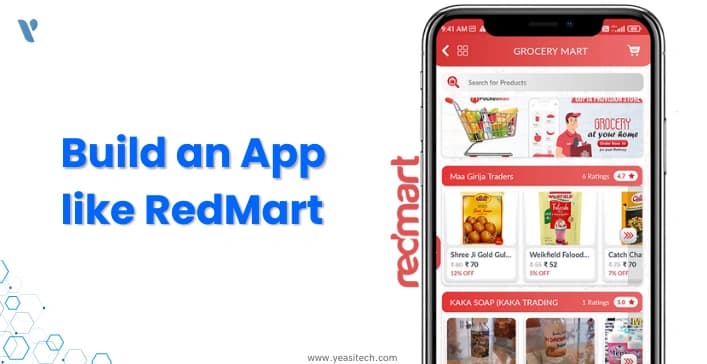
Singapore’s online grocery market crossed SGD 1.4 billion in 2025. Around 80% of residents buy groceries online at least once a month. Same-day delivery demand has grown 40% year-on-year since 2020. The market is real, the demand is consistent, and the infrastructure to serve it has been built out steadily by RedMart, FairPrice Online, Cold Storage, and Amazon Fresh over the past decade.
And yet most founders who decide to build in this space underestimate what it costs, and more importantly, why it costs that much. They compare it to a standard e-commerce app, look at the price of a Shopify build, and assume the gap between the two is a matter of feature count.
It is not. Grocery delivery is a different category of software problem entirely. The gap exists because a grocery app is not primarily a shopping interface. It is a real-time supply chain with a consumer app sitting on top. Every order triggers inventory reservations, slot checks, warehouse assignments, routing calculations, cold chain management, and live status updates simultaneously. Getting any one of those layers wrong produces failures that users notice immediately and do not forgive.
This guide covers what it actually costs to build a grocery delivery platform in Singapore in 2026, what drives those costs, what the Singapore market specifically demands, and the decisions that shape whether your platform is competitive or not.
Table of Contents
- What RedMart Actually Built?
- Why Grocery Apps Cost More Than Standard E-Commerce?
- Core Systems a Grocery Platform Requires
- Key Features and Their Cost Impact
- Technology Stack for a Production-Ready Platform
- Full Cost Breakdown: MVP to Growth Platform
- Development Timeline
- Compliance Requirements for Singapore Grocery Apps
- Ongoing and Post-Launch Costs
- Lessons from RedMart’s Growth
- How to Keep Development Costs Under Control?
- How YeasiTech Builds Grocery Delivery Platforms
What RedMart Actually Built?
Most people describe RedMart as a grocery version of Lazada. That comparison understates the complexity by a significant margin.
RedMart is not primarily a shopping interface. It is a warehouse operation, a cold-chain logistics network, an inventory management system, and a last-mile delivery platform, all running in coordination, with a consumer app as the point of access.
When a customer in Bishan orders chicken breast at 2 PM, expecting cold delivery by 6 PM, here is a partial sequence of what the system has to do:
- Confirm the item is in stock at the nearest fulfilment centre
- Verify batch quality and expiry date
- Reserve that specific unit so no concurrent order can claim it
- Check whether the 6 PM delivery slot for that zone still has capacity
- Generate a pick list for the warehouse team with the correct aisle and shelf location
- Assign a driver with a route that accounts for all pending orders in that zone
- Maintain cold chain compliance through transit
- Push real-time status updates to the customer at each stage
That is one order. On a normal weekend, RedMart processes tens of thousands simultaneously. Each one triggers the same chain of operations across inventory, logistics, payments, and communications in parallel. This is why building an app like RedMart costs significantly more than a standard e-commerce app. The catalogue and checkout are the visible layer. The real engineering effort is in the systems underneath.
Why Grocery Apps Cost More Than Standard E-Commerce?
A clothing e-commerce app can update stock every few hours. If an item sells out between a customer adding it to the cart and completing checkout, the resolution is a refund and an apology. That is a friction point, but it is recoverable.
A grocery app cannot work that way. If a customer orders the last two litres of whole milk and the system does not immediately reserve both units, the next customer who loads the same product page will see it as available. Both orders go through. One of them cannot be fulfilled. At 200 orders a day, that kind of inventory conflict is manageable manually. At 2,000, it is an operational breakdown.
Real-time inventory sync, concurrent slot management, route optimization across simultaneous deliveries, cold chain compliance tracking, and live order status are not premium features to be added later. They are the baseline requirements that make the platform usable. Each one requires substantial backend engineering to work reliably under load.
This is why quotes for an app like RedMart are higher than founders expect when they first start looking. The cost is not in the consumer-facing layer. It is in the operational systems that make fulfilment possible.
Core Systems a Grocery Platform Requires
Every grocery delivery app in Singapore is built on five interconnected systems. Each has its own design, development, and testing requirements. The platform is only as reliable as its weakest component, because all five run together during every order.
1. The Customer App
Product discovery, search and filtering, cart management, delivery slot selection, checkout, order tracking, and order history. This is the most visible part of the platform, and in Singapore specifically, load speed and checkout simplicity have a direct and measurable effect on conversion. RedMart reduced checkout steps from six to three during a 2019 UI overhaul and reported a 22% conversion improvement. The lesson is that design decisions here are commercial decisions.
2. The Warehouse Picker Interface
When an order comes in, a staff member at the fulfilment centre receives a picking list specifying which products to collect, from which location, in what sequence. This interface needs to be fast, accurate, and practical for people working in a warehouse environment on handheld devices. A poorly designed picker interface slows fulfilment time, increases picking errors, and scales badly as order volume grows.
3. The Delivery Driver App
Route optimisation, live order updates, proof of delivery capture, customer communication, and earnings tracking. Singapore’s mix of HDB blocks, condominiums, and private estates each have different access protocols and delivery entry points. A driver app and routing system that does not account for these specifics generates late deliveries and driver friction. Getting this right early avoids a common source of one-star reviews that have nothing to do with the product itself.
4. The Admin and Operations Panel
Inventory management, vendor coordination, pricing, promotions, delivery zone configuration, and reporting. A weak admin panel forces the operations team into spreadsheets and manual processes. That approach works at 100 daily orders. At 1,000, it creates bottlenecks that limit growth regardless of how well the consumer-facing app performs.
5. The Inventory and Supply Chain Backend
Real-time stock updates, batch and expiry date tracking, reorder point logic, vendor integration, and demand forecasting. This is typically the most underestimated component during scoping and the one that causes the most operational failures when it is underbuilt. Every other system depends on it for accurate data.
Key Features and Their Cost Impact
Features in an app like RedMart are not independent items that can be added or removed without consequence. They interact with each other through the backend. Understanding what each feature requires the system to do clarifies why the cost estimates are what they are.
1. Product Catalogue and Inventory Management
A searchable product database, real-time stock tracking, batch and expiry management, and filter logic. For Singapore specifically, halal certification tagging, dietary filters, and product origin information are expected by a significant portion of users and need to be built into the data model from the start, not retrofitted.
Estimated cost: SGD 25,000 to SGD 60,000 depending on catalogue size and inventory complexity.
2. Delivery Slot Management
Real-time slot availability checks, fulfilment centre capacity calculations, driver availability, and zone-specific booking rules. Slots need to account for geographic capacity independently, because a full slot window in Tampines does not affect availability in Clementi. This logic is more involved than it appears in the user interface.
Estimated cost: SGD 20,000 to SGD 50,000.
3. Payment Integration
Singapore requires PayNow, credit and debit card support, and increasingly GrabPay and other digital wallets. Each integration needs robust handling of partial refunds, failed transactions, and substitution adjustments. For platforms with subscription or top-up wallet models, recurring billing logic adds further complexity.
Estimated cost: SGD 8,000 to SGD 25,000.
4. Real-Time Order Tracking
Live GPS updates, driver assignment notifications, estimated arrival calculations, and in-app communication between customer and driver. This requires GPS integration, a real-time communication layer, and mapping APIs, all of which carry usage-based costs in production on top of the development investment.
Estimated cost: SGD 30,000 to SGD 80,000.
5. Personalization and Recommendations
Reorder suggestions, personalized promotions, and purchase-history-based product recommendations. These are not essential at the MVP stage, but have a measurable impact on repeat purchase rates, which is the core metric for a grocery business model that depends on weekly orders rather than occasional transactions.
Estimated cost: SGD 15,000 to SGD 40,000 when added post-MVP.
Technology Stack for a Production-Ready Platform
The right technology choices for a grocery delivery app in Singapore need to do three things: handle concurrent real-time operations reliably, scale with order volume without architectural changes, and integrate with Singapore’s payment infrastructure and regulatory requirements.
Choosing widely used, well-supported technologies matters more in a grocery delivery app Singapore teams build than in most other app categories because the operational demands are high and the need to hire, maintain, and extend the codebase over time is real. An unusual or experimental stack that saves money in the first sprint can become a significant cost and hiring constraint twelve months later.
Full Cost Breakdown: MVP to Growth Platform
Lean MVP (Single Fulfilment Zone, Core Features)
This delivers a working app like RedMart suitable for testing with real customers in a defined area of Singapore, with enough operational reliability to generate useful feedback.
Growth Platform (Multi-Zone, Advanced Features)
Built after MVP validation, these components add the operational depth and user-facing capabilities needed to compete at scale.
Development Timeline
Compliance Requirements for Singapore Grocery Apps
Compliance is where many projects building a grocery delivery app in Singapore run into avoidable costs mid-build, when addressing requirements discovered late is two to three times more expensive than building them in from the start. The requirements below apply to any grocery delivery platform collecting and processing user data in Singapore.
Ongoing and Post-Launch Costs
Development cost is the initial investment. The costs below are the ones that continue every month and determine the long-term unit economics of the platform.
Lessons from RedMart’s Growth
RedMart’s history is a more useful guide than it gets credit for. The decisions that made the platform successful were operational and strategic, not primarily technical.
1. They started with a focused problem, not a full feature set
RedMart launched in 2011 with one promise: reliable grocery delivery in a city where professionals had very little time to shop. The first version was not trying to replicate a full supermarket catalogue online. It solved a specific, well-defined problem for a specific kind of customer. The catalogue was limited, the delivery zones were defined, and the team focused on operational reliability before scale.
Founders who try to build an app like RedMart’s current full feature set from day one spread development budget and operational capacity too thin before they have learned what their specific users actually need.
2. Operations determined success more than features
In the early years, RedMart invested heavily in warehousing, cold-chain logistics, and inventory synchronisation before most founders would have considered it necessary. They built routing algorithms that reduced delivery inefficiency by around 25%, which compounded into significant cost savings per order as volume grew.
The app is the access point. The warehouse operation, the delivery network, and the inventory system are what determine whether orders are fulfilled correctly and on time. Founders who treat these as secondary concerns build platforms that look right but fail operationally.
3. Personalization improved retention before it was fashionable
RedMart implemented reorder suggestions, personalised discounts, and purchase-history-based recommendations relatively early. The effect was measurable in repeat order rates. Grocery delivery economics depend on weekly repeat orders, not on acquiring new customers continuously. Features that increase the probability of a repeat order are worth more over twelve months than features that improve the new user experience.
4. Partnerships extended what the platform could do
In 2016, under competitive pressure and rising scaling costs, RedMart partnered with Lazada rather than continuing to build all capabilities independently. The partnership provided access to last-mile delivery infrastructure and supply chain systems that would have taken years and significant capital to replicate. The decision accelerated growth rather than compromising it.
For early-stage grocery platforms, third-party delivery services like GrabExpress, Lalamove, and Pickupp can provide last-mile coverage during the validation phase at a fraction of the cost of building proprietary logistics.
5. Technology investment paid back over time
RedMart treated backend infrastructure, automated warehouse systems, and data analytics as foundational investments rather than costs to minimise. Those systems were what allowed the platform to handle high daily order volume without operational breakdown. The compounding return on early infrastructure investment made the platform competitive in ways that were difficult for later entrants to replicate quickly.
RedMart’s biggest lesson is straightforward: the platform grew by being reliably good at one thing before expanding to many. That sequencing is the model worth following.
How to Keep Development Costs Under Control?
Building an app like RedMart does not require spending at the upper end of the ranges in this guide from the start. The decisions below consistently produce better results per dollar invested.
1. Launch in One Delivery Zone with a Focused Catalogue
A single fulfilment area and a catalogue of 500 to 800 high-velocity SKUs reduces backend complexity, operational risk, and development time substantially. The data from real orders in that zone tells you what to build next better than any pre-launch assumption.
2. Use third-party Delivery Logistics in Year One
Building proprietary routing technology, a driver app, and a fleet management system adds SGD 80,000 to SGD 150,000 to an early build and requires operational infrastructure that takes months to establish. GrabExpress, Lalamove, and Pickupp handle last-mile delivery reliably across Singapore. Using them during the validation phase keeps the initial build focused on what differentiates your platform.
3. Use cross-platform frameworks for the consumer and driver apps
Flutter and React Native cover both iOS and Android simultaneously at roughly 30 to 40% less than building two native apps. For a grocery delivery app Singapore teams build at MVP stage, the performance trade-off is minimal.
4. Apply for startup cloud credits before development begins
AWS, Google Cloud, and Azure all offer substantial credits for early-stage companies, often covering SGD 10,000 to SGD 50,000 in infrastructure costs. These credits can cover the bulk of hosting expenses for the first six to twelve months.
5. Use pre-built modules for standard components
Authentication, OTP verification, payment gateway integration, and admin dashboard frameworks are all available as tested modules or APIs. Custom-building these from scratch adds cost and time without adding competitive value. Development budget is better spent on the inventory management system, the delivery slot logic, and the cold chain tracking, the components that are specific to the product and hard to replicate quickly.
6. Invest in discovery before development begins
Two to four weeks spent mapping operational workflows, identifying compliance requirements, and planning the system architecture before a line of code is written reliably saves four to six weeks of rework mid-build. The biggest cost overruns in grocery app development come from compliance requirements found mid-build and integration dependencies discovered after architecture decisions were already made.
How YeasiTech Builds Grocery Delivery Platforms
Most development agencies build what they are asked for and hand it over. Building a production-grade app like RedMart for the Singapore market requires more than that: domain knowledge of how grocery fulfilment actually works, practical experience with PDPA and MAS compliance requirements, and a development process that surfaces the hard problems at the start rather than mid-build.
YeasiTech has helped founders build on-demand delivery platforms and marketplace products across Southeast Asia. Our approach to mobile app development is built around modular architecture, transparent scoping, and honest conversations about what to build first and what to defer.
We have pre-built and tested modules for cart logic, checkout flows, delivery slot management, and driver routing. These reduce development time on components that follow well-established patterns, so the budget goes further on the parts that are genuinely specific to your platform.
We build PDPA compliance into the data architecture from the start, not as a retrofit. We scope payment integration against Singapore’s specific gateway and regulatory requirements before development begins. And we run a structured discovery sprint at the outset that maps your operational workflows against the technical requirements and flags the gaps that would otherwise surface at the worst possible time.
If you are planning to build an app like RedMart in Singapore and want a realistic picture of what it costs for your specific scope, get in touch for a free consultation. We will scope it properly and give you numbers built around your actual plans.

1. How much does it cost to build an app like RedMart in Singapore?
A lean MVP covering the customer app, warehouse picker interface, driver app, admin panel, inventory management, and basic real-time tracking typically runs SGD 173,000 to SGD 387,000 depending on scope, catalogue size, and delivery zone complexity. A growth-stage platform with multi-zone routing, personalisation, and multi-vendor capability adds another SGD 145,000 to SGD 345,000. The right number for a specific project depends on clearly defined scope, not a standard formula.
2. Why does building an app like RedMart cost more than a standard e-commerce app?
Because the real-time operational requirements are fundamentally different. A standard e-commerce platform can update stock hourly and handle fulfilment sequentially. A grocery platform needs real-time inventory sync across concurrent orders, live slot management, route optimization, cold chain tracking, and live order status updates simultaneously. Each of those is a substantial engineering problem in its own right. Together, they account for most of the cost difference.
3. How long does it take to build a grocery delivery app in Singapore?
A lean MVP takes 6 to 9 months with an experienced team. A more constrained version with a limited catalogue and single delivery zone can be delivered in 4 to 5 months. A full-featured app like RedMart with multi-vendor support, personalisation, and advanced routing takes 10 to 14 months. The inventory management backend and real-time tracking consistently take longer than initial estimates because of their integration complexity and edge case volume.
4. Do I need separate apps for customers, pickers, and drivers?
Yes. All three user groups have completely different operational needs and workflows. Combining any of them produces an interface that serves none well. The warehouse picker interface is the most commonly underbuilt component in early grocery platform builds, and its quality directly determines fulfilment accuracy and speed.
5. What Singapore-specific compliance requirements apply?
The key requirements are PDPA compliance for user data handling, Payment Services Act considerations for platforms processing payments or managing wallet balances, Food Safety Regulations for platforms involved in food handling, and Consumer Protection Act requirements for accurate product descriptions and pricing. PDPA compliance is the most commonly missed and the most straightforward to build correctly from the start.
6. What ongoing costs should I plan for after launch?
Cloud hosting runs SGD 800 to SGD 8,000 per month depending on order volume. Mapping and GPS API costs run SGD 200 to SGD 3,000 per month. Payment gateway fees are 2 to 3% per transaction. App maintenance runs SGD 3,000 to SGD 8,000 per month. In total, plan for SGD 80,000 to SGD 200,000 per year in baseline operating costs, excluding new feature development and marketing.