
The on-demand laundry market is still wide open in most cities. Washmen cracked it in Dubai. If you’re a founder eyeing a similar opportunity, the first real question isn’t whether to build – it’s how much it’ll cost and whether the numbers actually work.
This guide gives you real figures, explains what drives the price up or down, and helps you decide what to build first.
What the Market Looks Like Right Now
The global on-demand laundry market is projected to hit $37.3 billion in 2025, growing toward $722.4 billion by 2035 at a 30% compound annual growth rate. That growth is coming from one place: people with money and no time.
Dual-income households are now the norm. Nobody wants to spend Saturday at a laundromat. Smartphones made it possible to solve this with three taps. The timing has never been better for founders who can execute well on logistics.
What You’re Actually Building
Most people look at Washmen and see one app. It’s actually three systems that have to work together in real time.
The customer app handles registration, service selection (wash and fold, dry cleaning, speciality items), scheduling, order tracking, cashless payments, and stain reporting.
The driver/delivery app manages pickup assignments, route optimization, order status updates, and earnings tracking. This is a completely separate interface with its own logic.
The admin dashboard is where you run the business – order management, customer data, driver oversight, payment reconciliation, analytics, and support tools.
The backend infrastructure ties all three together. It handles authentication, real-time syncing, push notifications, payment processing, and data storage. Understanding this full picture is why the cost range is wider than most people expect.
For a deeper look at how these systems fit together in an on-demand app, see our full guide to building an app like Uber.
How Much It Costs: Tier Breakdown
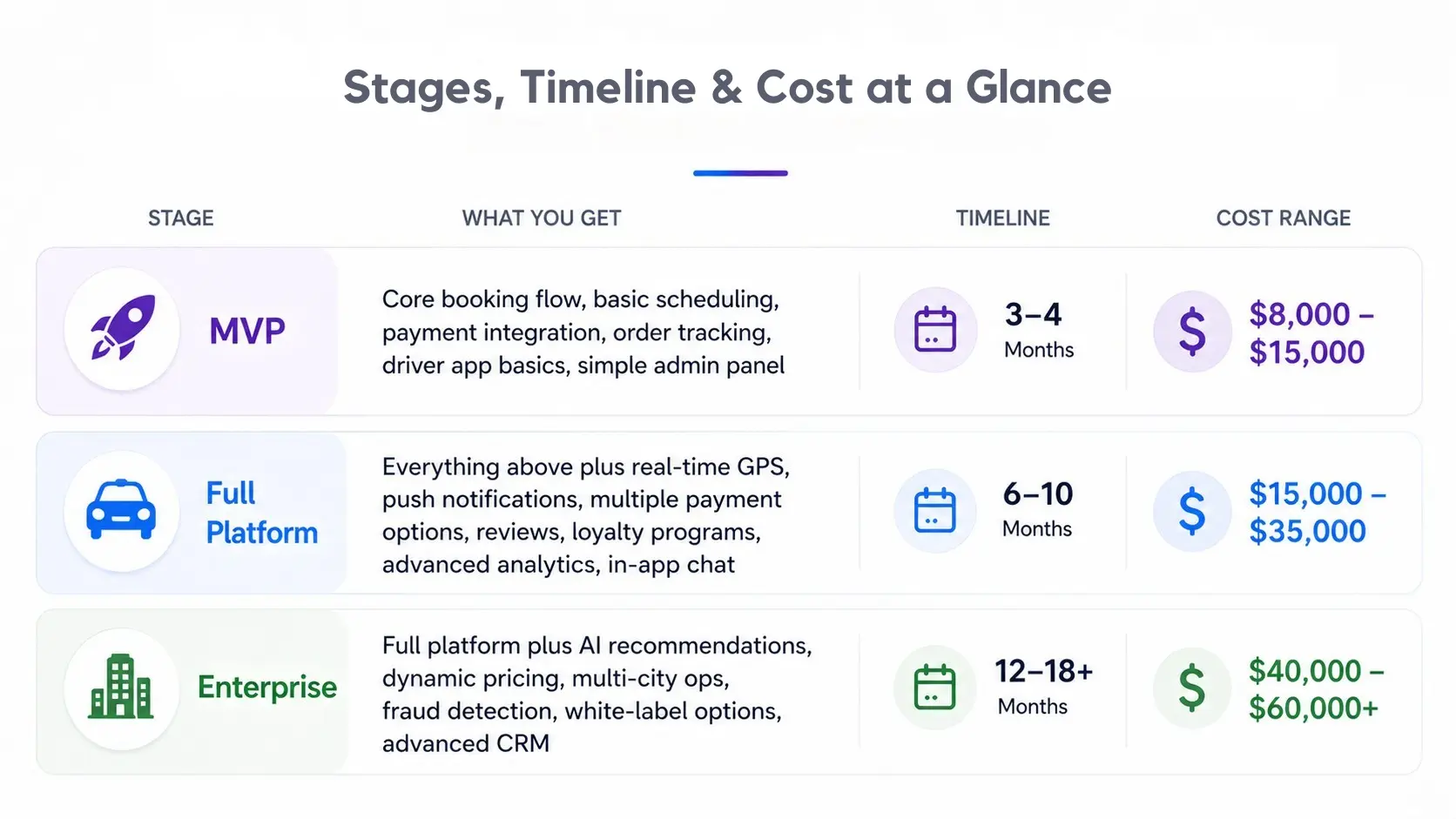
Start with the MVP. Even if you have more budget available, launching a leaner product faster lets you validate demand with real users before committing to the full build. Many successful on-demand apps raised their Series A after proving traction on an MVP, then rebuilt properly with investor money.
The full-featured platform is where the product starts feeling like a serious business. Real-time tracking alone reduces customer support load significantly. That range makes sense once you start adding reliable notifications, proper analytics, and a review system.
Enterprise is for founders who have already proven the model and need to scale across cities or white-label to other operators.
How Location Changes Your Budget
The same app can cost 5 to 10 times more depending on where your development team is based. This is the biggest lever most founders don’t use well.
A common approach that works well: hire one senior technical lead locally to own quality and product decisions, and have them manage a development team in a lower-cost region. You get the strategic thinking where it counts while keeping the hourly rate manageable.
YeasiTech works with this model – experienced on-demand app delivery at offshore rates, without the coordination headaches that come with cheaper freelancers who’ve never built something like this before. See how much it costs to hire a mobile app developer in 2025 for a full breakdown by skill and region.
Feature-by-Feature Cost Estimate
Cost ranges vary by team location. The “Essential” group is non-negotiable for any working product. High-priority features like tracking and notifications should make it into your MVP if budget allows – they directly reduce support tickets and churn. The medium-priority items can wait for version two once you have paying users.
Note that scheduling is more complex than it looks. It has to prevent double-booking, manage driver capacity, handle rescheduling, and account for processing time at the facility. Get this wrong and your operations fall apart fast.
Ongoing Costs to Budget For
Development costs get the most attention, but the costs that follow are what actually determine whether the business is viable.
Most founders underestimate support costs. When someone’s order is late or clothes go missing, they want a fast response. Budget for this from day one, especially in the first few months when your processes are still being worked out.
How Laundry Apps Make Money
Understanding revenue models matters before you finalize features, because some models require capabilities that others don’t.
Washmen combines several of these. Most profitable laundry apps do the same. If you own the facility, you control margins better. If you’re building a marketplace connecting users with local providers, you trade margin for lower startup capital.
For a similar revenue model thinking applied to another on-demand category, see the true cost of building an app like Blinkit.
How to Approach the Build
Start with operations, not features. The app is the easy part. Consistently picking up and returning clean laundry on time is hard. Before writing a line of code, know your processing partner, your pickup radius, and how you’ll handle same-day demand.
Define your MVP scope tightly. The essential six features in the table above are enough to prove the concept. Resist adding loyalty programs or AI recommendations to v1. Launch fast and learn what users actually want.
Choose a cross-platform for the early stage. React Native or Flutter lets you ship iOS and Android from one codebase. You save 30-40% compared to native builds for each platform. Switch to native only when performance genuinely demands it. Read native vs hybrid app development to understand the tradeoffs before deciding.
Build for scale from the start. Cheap architectural shortcuts in your MVP create expensive rewrites later. The backend especially – if you build it to handle 100 orders and suddenly need to handle 10,000, you’ll be rebuilding rather than growing. See our MVP development guide for startups for how to balance speed with proper architecture.
Plan your launch marketing before you launch. Referral programs, partnerships with apartment buildings and corporate offices, and targeted local ads have all worked well for on-demand laundry startups. The app won’t market itself.
FAQ
How long does it take to build a laundry app like Washmen?
A working MVP typically takes 1 to 2 months with a dedicated team. A full-featured platform with real-time tracking, reviews, and loyalty features takes 4 to 6 months. Timeline depends heavily on how clearly requirements are defined before development starts – vague requirements add months.
Can I build a laundry app without owning a facility?
Yes. Many laundry apps use a marketplace model, connecting customers with existing laundry providers who handle processing. This requires less upfront capital but gives you lower margins and less control over quality. The alternative is to partner with one facility exclusively and focus entirely on customer acquisition and logistics.
What is the minimum viable budget to launch a laundry app?
With an offshore development team in India or Eastern Europe, a working MVP with the six essential features costs $8,000 to $15,000. Add $500 to $1,000 per month for infrastructure, support, and basic marketing. Plan for $15,000 to $25,000 total to get through the first three months post-launch.
What is the hardest technical part of building an app like Washmen?
Real-time coordination between customers, drivers, and processing facilities. You need accurate tracking that updates without delay, notifications that fire at the right moment, and logic that handles cancellations, delays, and edge cases gracefully. Teams with no prior experience in on-demand logistics routinely underestimate this.
How do I choose the right development team?
Look for teams with at least one completed on-demand service app in their portfolio – ideally something with driver management and real-time tracking. Ask to see how they handled the scheduling and logistics layer specifically. Generic app development experience is not enough for the operational complexity involved here. YeasiTech specializes in on-demand platforms and can walk you through their prior work.
Does the app need to be built for both iOS and Android?
For most markets, yes. Skipping one platform means losing a significant chunk of potential users. Use a cross-platform framework like React Native or Flutter to build both simultaneously at a lower cost than building two native apps.
What features should I cut from my MVP to save budget?
Loyalty programs, AI-based recommendations, advanced analytics dashboards, and in-app chat support can all wait for version two. Your MVP needs booking, scheduling, payments, tracking, the driver app, and the admin panel. Everything else is an upgrade once you have paying users.
Ready to Start?
YeasiTech has built on-demand service platforms for founders at this exact stage. They know which features actually drive retention and which ones waste your early budget. Whether you’re starting with a $10,000 MVP or planning a full platform build, get in touch with the YeasiTech team to map out the right scope for your market and budget.