
A senior developer in Dubai costs AED 40,000 to 60,000 per month in salary alone. Add visa, health insurance, gratuity, and office space, and a team of four runs AED 1.8 million to AED 2.6 million per year. That is the number most Dubai business owners see right before they start asking about offshore development.
This guide gives you a straight answer. What local development actually costs in 2026, what a quality Indian agency costs for the same work, how those numbers translate into real project budgets, and what determines whether the savings materialise or disappear into rework and delays.
What Software Developers Actually Cost in Dubai in 2026?
Let’s start with the local market. These are the rates companies are actually paying in Dubai right now, not what the job boards advertise. Understanding these numbers is the first step in deciding whether to outsource software development in Dubai or hire locally.
The salary is just the floor
On top of every Dubai developer’s salary: UAE employment visa (AED 5,000 to 8,000/year), health insurance (AED 6,000 to 15,000), end-of-service gratuity under UAE Labour Law (minimum one month per year of service), equipment and licences (AED 8,000 to 15,000 upfront), and office space (AED 30,000 to 60,000 per person per year in a business district). None of these costs exists when you outsource software development from Dubai. It is one of the most immediate financial differences between choosing to outsource software development in Dubai versus hiring locally.
Look at that last row again. One mid-level developer in Dubai, fully loaded, costs between AED 449,000 and AED 658,000 per year. A developer of the same calibre, accessed by outsourcing software development from Dubai to India, costs between AED 55,000 and AED 110,000 for the same output. A team of five in Dubai runs AED 2.2 million to AED 3.3 million annually. The same five-person outsourced team costs AED 275,000 to 550,000.
That is not a rounding error. That is the entire economic argument for outsourcing software development from Dubai. When businesses run through this table for the first time, the decision to outsource software development in Dubai versus hire locally stops being a cost question and becomes a strategy question. And it explains why so many businesses that started by hiring locally eventually call us.
What is the Same Work Cost When You Outsource to India?
India is the world’s second-largest developer community, on track to become the largest by 2027. The engineers that Google, Microsoft, and Amazon run their India operations with are the same talent pool you access when you take this approach. The cost difference is not the capability. It is the structural salary gap between two very different economies. A senior developer in India earns in a year what their Dubai equivalent earns in six weeks. That gap is why outsourcing software development in Dubai to India produces savings at the scale it does, and why the model has become standard practice for UAE businesses that need to build quickly without exhausting their budget on headcount.
A word on the cheap end: you can find developers at $8 to $12 per hour. Most are not appropriate for a product your business depends on. The $25 to $60 range is where reliable outsourced software development from Dubai to India happens. It is still dramatically cheaper than the Dubai equivalent. Do not cut below it to save a few extra percentage points and risk expensive rework that erodes the entire saving.
An agency rate also covers more than just developer time. At quality-tier agencies, the rate includes project management overhead (10 to 15% of the team), tooling, and coordination infrastructure. What is not included: production hosting and cloud costs, third-party API licences, and specialist services like dedicated UI/UX design if outside the agreed scope. Make sure your statement of work is explicit about what is in and out before you sign. This applies to any outsourced software development engagement, not just when you outsource software development from Dubai to India.
Project Cost Comparison by Type
The ranges in this table come from real project quotes in the Dubai market and our own delivery cost structures. The savings are genuine and consistent. The variable is quality, and that is entirely within your control if you run a proper evaluation before you choose who to work with.
One example from YeasiTech’s own delivery: a Dubai PropTech client received a local agency quote of AED 480,000 for a six-month property listing and management platform build. Using the hybrid model, the same scope delivered at AED 168,000. The AED 312,000 saving funded six additional months of marketing and a second product iteration.
The 60 to 65% saving holds across project sizes because the dominant cost is always engineering time, and engineering time in India costs roughly 60 to 65% less than Dubai on a fully-loaded basis. A project costing AED 300,000 locally typically runs AED 100,000 to 120,000 when you outsource software development from a quality Indian agency. That AED 180,000 difference is runway, additional features, or the difference between a startup that survives and one that runs out of budget six months before launch. The comparison assumes quality-matched partners on both sides. A premium Dubai agency versus a budget Indian agency will produce a different ratio. The table above reflects
YeasiTech clients pay when they outsource software development through our hybrid model, compared to the local agency quotes they received for the same scope. Timeline is a separate variable: some businesses that outsource software development in Dubai to India find that the communication overhead adds 10 to 15% to timelines. Others find that staffing from India’s larger talent pool is actually faster than waiting for Dubai’s market. The experience you have depends almost entirely on how well the offshore engagement is structured.
Beyond Cost: What Actually Determines Success
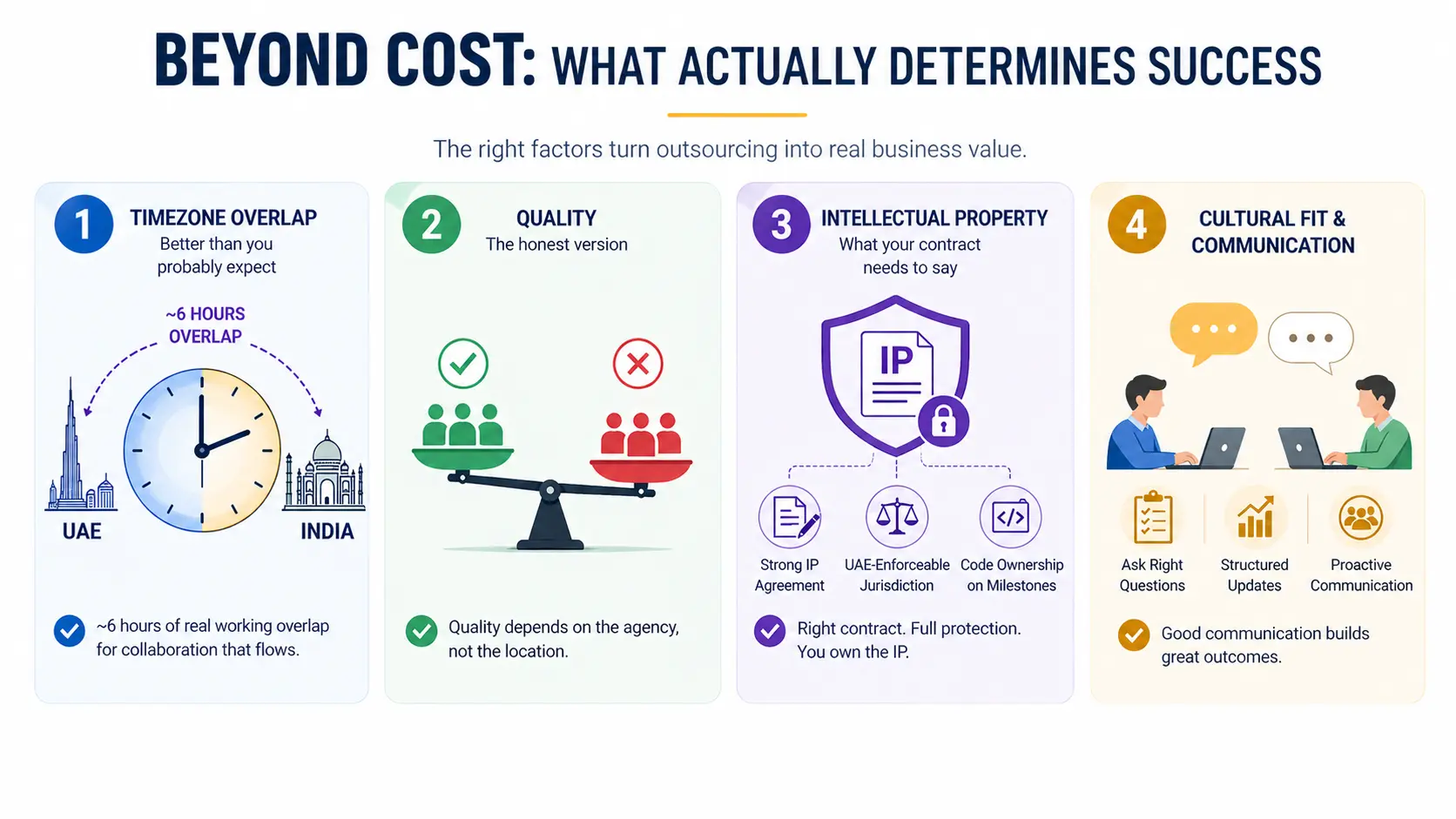
Cost is the easy part. Every business owner can do the maths. The harder questions are the ones that determine whether the savings get realised, or whether the cheaper option ends up costing more once you factor in delays, rework, miscommunication, and IP disputes. Here is an honest look at each factor that matters when you outsource software development from Dubai.
1. Timezone Overlap: Better than you Probably Expect
India is 1.5 hours ahead of the UAE, giving roughly six hours of genuine working-day overlap. That is sufficient for daily standups, real-time problem-solving, and end-of-day handoffs. Businesses that outsource software development from Dubai to India consistently describe the time zone as a non-issue within the first few weeks. Compare that to Eastern Europe (3 to 4 hours difference), East Asia (4 to 5), or Latin America (7 to 9) and the UAE-India relationship is the most practical timezone pairing available for businesses outsourcing software development in Dubai to an offshore team.
2. Quality: The Honest Version
India produces the engineers who build for the world’s largest technology companies. But the offshore market ranges from excellent to genuinely poor, and the hourly rate tells you nothing about which end you are getting. The quality variable is agency selection, not national origin. A well-run outsourced software development engagement based in Dubai delivers outcomes equivalent to those of a strong local team. A poorly run one produces rework, delays, and disputes that cost more than the savings. Section 5 covers exactly how to tell a good agency from a poor one before you commit any budget when you outsource.
3. Intellectual Property: What your Contract Needs to Say
IP protection is where many business owners have real anxiety about outsourcing software development from Dubai. The reassuring reality is that IP protection through contract is well-established in the India-UAE cross-border context. A properly drafted development agreement with explicit IP assignment clauses, an NDA with UAE-enforceable jurisdiction (DIFC or ADGM arbitration both work well), and code ownership transfer provisions tied to payment milestone completion are standard practice at reputable Indian agencies. Outsourcing software development from Dubai does not mean giving up IP control. It means making sure your contract covers it explicitly.
The risk is not with agencies that have done this before. The risk is with agencies that resist signing a clean IP assignment agreement, or whose contracts use vague language around code ownership. If a potential outsourcing partner is reluctant to sign a clear IP agreement with UAE-enforceable terms, stop the conversation. Every agency worth outsourcing software development from Dubai to will sign one without hesitation.
4. Cultural Fit and Communication Style
Indian development agencies that serve international clients have generally adapted well to the communication expectations of professional business relationships. Structured status updates, proactive issue escalation, and formal project documentation are the norm at quality shops, not exceptions. The thing to watch in early conversations is whether the agency asks the right questions before quoting. Agencies that rush to price a project before understanding the scope make poor outsourced software development partners, whether you are outsourcing software development from Dubai or from anywhere else. The ones that slow down and ask clarifying questions are usually the ones that build what you actually need.
When to Build in Dubai and When to Outsource?
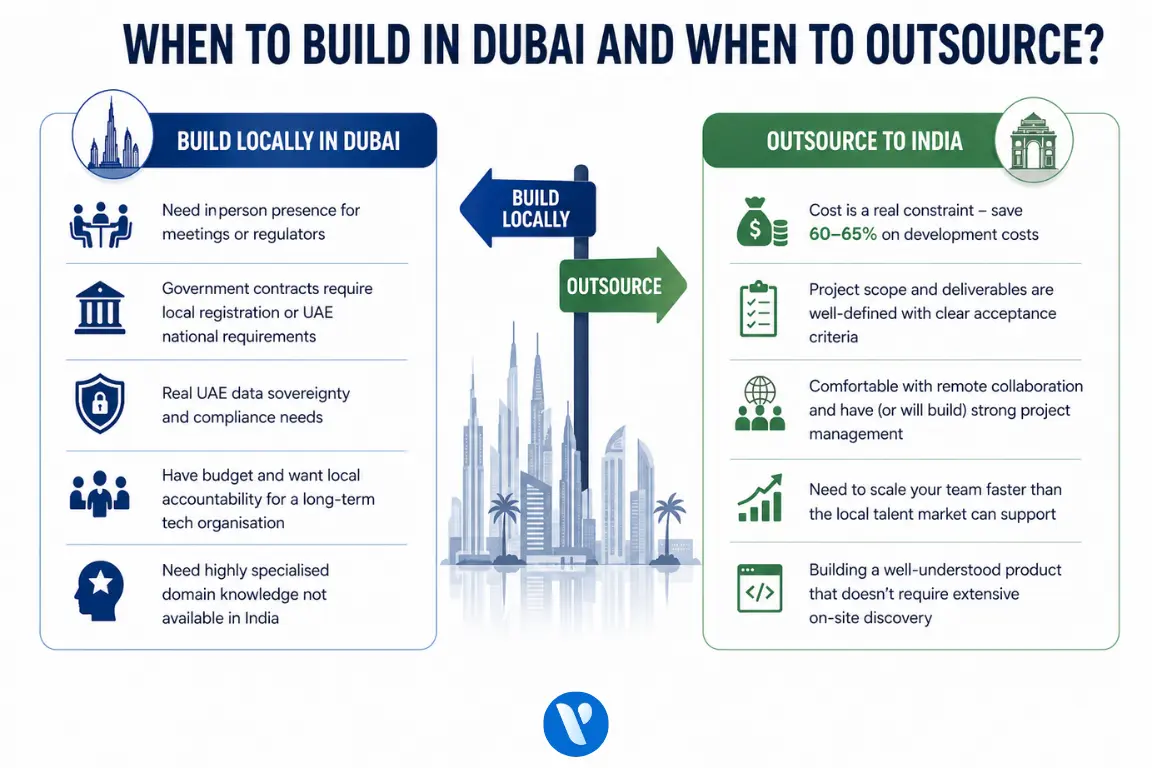
There is no single right answer to whether you should outsource software development from Dubai or build locally. The decision depends on your project, your budget, your timeline, and where you want to be in three years. Here is the framework we use when UAE business owners ask us directly.
Build Locally in Dubai When:
- You need regular in-person presence at client meetings, government offices, or regulatory bodies that require physical attendance and will not accept remote representation.
- Your contract is with a government entity that mandates a locally registered technology firm or UAE national employment requirements as part of the award terms.
- Your product handles data with genuine UAE data sovereignty requirements that create real compliance barriers to remote development, not just theoretical ones.
- You have the budget, you want local accountability throughout the project, and you are building a long-term technology organisation rather than a single product.
- Your domain requires extremely specialised knowledge that does not exist at the required level in India’s development market.
Outsource Software Development from Dubai When:
- Development cost is a real constraint, and you need to maximise what you build within a defined budget. Outsourcing software development from Dubai to India saves 60 to 65% on average compared to local agency or employment costs.
- Your project scope is well-defined and documented, and you have clear, measurable acceptance criteria for each deliverable before work starts.
- You are comfortable with remote-first collaboration and either have experience managing outsourced software development relationships or are willing to invest in good project management structure.
- You need to scale your development team faster than Dubai’s talent market can accommodate at the speed or budget you require.
- You are building a technically well-understood product that does not require extensive on-site discovery sessions that remote working genuinely cannot replace.
The mistake most business owners make is treating this as a permanent, binary choice. In practice, many successful UAE companies follow this process to build and validate their first product, then hire a small core technical team locally once the product is generating revenue, and they know exactly what in-house talent they need. Spend outsourced rates to validate the idea. Spend Dubai rates to run the proven business. That sequencing makes economic sense in almost every scenario where outsourcing software development from Dubai is genuinely viable.
Worth saying plainly: The decision to outsource software development in Dubai does not mean accepting lower quality. The quality gap between a good Dubai agency and a good Indian outsourcing agency is negligible for most software project types. The quality gap between a good agency and a poor one, wherever they are located, is enormous. Location is not the quality variable. Due diligence in partner selection is.
The Hybrid Model: Dubai Management, India Engineering
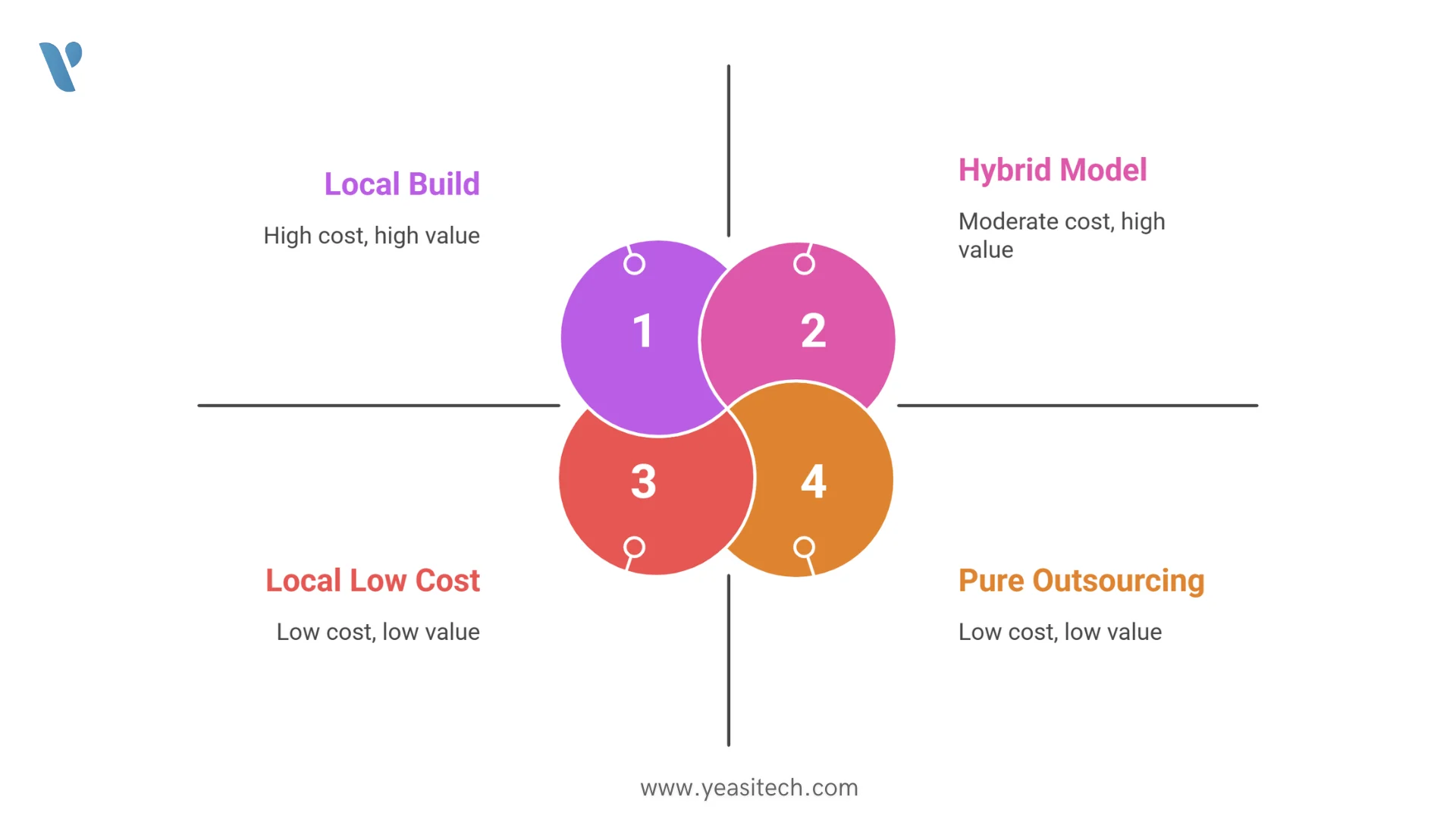
The pure outsource model, where a Dubai business hands a project brief to an offshore team and waits for delivery, has a mixed track record. The hybrid model has consistently better results. This is the structure used by most UAE businesses that successfully outsource software developers over multiple projects.
What the Hybrid Model Actually Looks Like?
A UAE-based project manager or account director owns the entire client relationship: attending in-person meetings in Dubai, managing the commercial side, handling any local compliance questions, and translating business requirements into engineering specifications that the offshore team can execute on. The engineering team works from India at Indian salary rates, managed through a structured remote delivery process with daily standups, sprint reviews, and documented communication throughout. For businesses that want to outsource software development from Dubai without losing the feel of a locally managed project, this is the structure that makes that possible.
The client gets a local contact they can meet in person. They also get the 60 to 65% cost saving that comes from outsourcing the engineering work from Dubai. The practical tradeoff is that the full engineering team is not on-site. In a world where Figma, GitHub, Slack, and Zoom are the primary tools of software development, the impact of that tradeoff is genuinely smaller than it was five years ago.
What does the Hybrid Model cost?
A hybrid outsourced software development engagement with YeasiTech works like this: a UAE-based project management fee of 10 to 15% of total project cost (covering local oversight, client communication, and requirements management), plus the offshore engineering cost at India rates. For Dubai businesses that want to outsource software development but keep a local face on the account, the total typically comes in at 35 to 45% of the equivalent fully local Dubai build.
On a project that would cost AED 400,000 with a local Dubai team, a hybrid outsourcing engagement typically runs AED 140,000 to 180,000. That is a saving of AED 220,000 to 260,000, with a project manager the client can call, meet, and escalate to at any point in the process.
Why this Structure Works When Pure Outsourcing Does Not?
Most failed outsourced software development relationships do not fail because of engineering quality. They fail because of the communication gap between what the client expected and what the remote team interpreted from the brief. A local project manager who understands both the UAE business context and the technical requirements, and who can translate accurately between the two, closes that gap almost entirely.
The UAE businesses that chose to remote development without a local management layer, and then moved to the hybrid model, consistently report better delivery, fewer scope disputes, and faster timelines. The PM overhead is an extra 10 to 15% on the project cost. The value it returns when you are outsourcing software development from Dubai across a multi-month engagement is considerably more than that.
Choosing who to outsource software development to is the highest-leverage decision in the entire process. Get it right, and you get a reliable partner and real savings. Get it wrong and you spend more than building locally by the time you account for rework, delays, and starting over. Here is how to evaluate properly before you outsource, so the decision to outsource software development in Dubai produces the outcome you expect.
Tip From the YeasiTech team: The hybrid model is not something we arrived at by accident. It is the structure we designed specifically because pure outsourcing of software development from Dubai to India tends to fail at the client communication layer, not the engineering layer. Our UAE-based team handles everything client-facing. Our engineering team handles everything development-facing. The handoff between them is seamless because both sides work inside the same organisation and use the same project management processes.
How to Evaluate Offshore Partners?
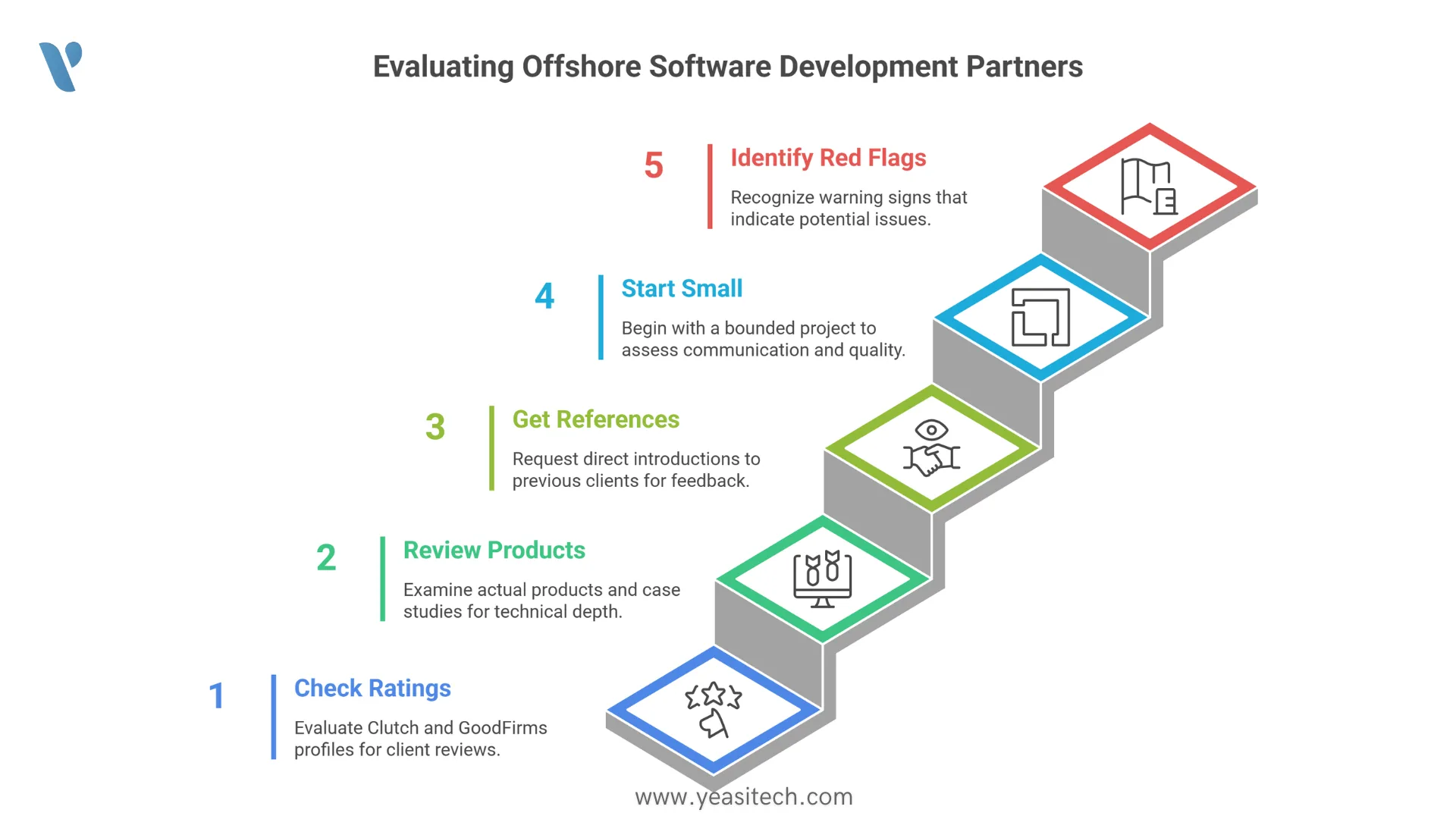
Most guides on outsourcing software development from Dubai tell you to check portfolios and read reviews, then leave you to figure out the rest. Here is the actual process for evaluating whether an offshore partner is worth committing to.
Step 1: Check Clutch and GoodFirms Ratings
Both platforms verify client reviews through a structured interview process that is meaningfully harder to fabricate than a company’s own website testimonials. When you look at a potential outsourcing partner’s Clutch or GoodFirms profile, do not just look at the overall score. Read the review text, and filter for clients whose industry, project type, and budget match yours. A strong rating from a company that outsourced a basic website tells you very little about whether this agency can handle a complex fintech or real estate platform. When you outsource software development, look for evidence that matches your situation specifically.
Step 2: Look at the Actual Products, not the Logos
A homepage covered in client logos is not a portfolio. What you need is the actual product: a live URL, a working demo, or a genuinely detailed case study that explains the problem, the technical approach, and the measurable outcome. Ask the agency to walk you through two or three projects similar to yours on a screen share call. Listen for whether they can discuss technical decisions with substance, or whether they only know how to show you screenshots. An outsourced software development partner that cannot explain why they made specific architecture choices will not make good ones on your project either.
Step 3: Get Real Client References
Ask for direct introductions to two or three previous clients in sectors similar to yours. Not just names and email addresses to cold-contact yourself. Ask the agency to facilitate the introduction. Any outsourced software development partner worth working with has happy clients willing to speak with prospects on their behalf. If the agency stalls, offers references that turn out to be unresponsive, or redirects you to generic testimonials, treat it as a significant red flag.
When you do speak to references, ask the questions that matter: how did they handle a project that went off track? What happened when you disagreed on scope? Would you outsource remote development to this team again, and if not, what would you do differently? Those answers are worth more than any case study or Clutch rating.
Step 4: Start with a Small, Bounded Project
Before committing to a multi-month engagement, run a bounded first project: a discovery sprint, a single feature build, or a technical audit. YeasiTech’s MVP development guide covers how to structure this. A small first outsourced software development project gives you real data on communication, responsiveness, and code quality before you commit to outsourcing software development from Dubai at full scale.
Red Flags That Should Make You Walk Away
- A quote within 24 hours before the agency has asked a single clarifying question about your requirements.
- Reluctance to sign an IP assignment agreement with UAE-enforceable terms. Every serious outsourced software development partner will sign one immediately.
- Senior developers named in the proposal who are not on your actual team when work begins. This is one of the most common ways outsourced software development engagements disappoint.
- No dedicated project manager. When you outsource software development, a PM layer between you and the engineering team is non-negotiable. Without one, developers manage client communication directly and quality suffers.
- Vague answers on scope changes, post-delivery bugs, or missed sprint deadlines. These are standard questions every business outsourcing software development from Dubai should ask before signing.
The outsourced software development market has outstanding partners and ones that will cost you more than building locally ever would. Every business that fails when it tries to outsource software development from Dubai skipped part of this process. Running through it takes two to three weeks and clearly separates serious agencies from poor ones, removing most of the risk from the decision to outsource software development in Dubai.
How to Get Started With Offshore Development
Knowing whether to outsource is one thing. Starting the engagement correctly is another. Most failed offshore relationships fail in the first four weeks, not because of engineering quality, but because the setup was wrong.
Step 1: Define Your Stack and Scope
Write down the technology your project uses, the experience level you need, and the hours per week required before talking to any agency. Vague briefs produce vague quotes. A brief that specifies “senior React developer, Next.js, TypeScript, 40 hours weekly, UAE business hours” attracts the right partners. “I need a developer” attracts everyone.
Step 2: Choose Your Model
Four models exist for offshore engagement. Freelancers suit short projects under three months with clear deliverables. Dedicated developers work for ongoing product builds that require business context. Development agencies fit teams needing end-to-end delivery without in-house technical leadership. Staff augmentation works when scaling an existing team while keeping control. Most Dubai businesses start with an agency for the first build, then shift to dedicated developers once the product is live.
Step 3: Run a Trial Project First
Never sign a multi-month contract without a paid trial. A two to four week trial on a real task from your project costs AED 3,000 to 8,000 and tells you everything about how the team communicates, how they handle feedback, and whether they meet deadlines. Ending a trial costs far less than exiting a three-month engagement that went wrong.
Step 4: Onboard With Context, Not Just Access
Give the team your business context, not just system access. What problem does the product solve? Who are the users? What decisions led to the current architecture? Developers who understand why they are building something make better technical decisions than developers working from a spec in isolation.
Step 5: Manage for Outputs
Track work through deliverables and sprint reviews, not hours logged. Daily standups keep remote teams aligned. Clear acceptance criteria for each task remove the ambiguity that causes scope disputes. Developers who know what done looks like deliver it. Developers who are guessing deliver something close and wait for feedback.
Common Questions About Outsourcing Software Development From Dubai
How much can I actually save when I outsource software development from Dubai to India?
Consistently 60-65% on total project cost against quality-matched partners. A project costing AED 300,000 locally typically runs AED 100,000 to 120,000 through a reputable Indian agency. The saving is structural, driven by the salary gap between the UAE and India, and it holds across project sizes from MVPs to enterprise platforms.
Is quality really comparable between local Dubai teams and outsourced Indian teams?
For most project types, yes. India produces engineers that build for the world’s largest technology companies. The quality variable is agency selection, not national origin. A rigorous evaluation process matters more than geography. The process in the evaluation section above covers exactly how to assess this before committing any budget.
What is the realistic timezone experience when working with an Indian dev team?
India is 1.5 hours ahead of the UAE. When your Dubai team starts at 9am, your Indian team is already at 10:30am. There are roughly six hours of genuine working-day overlap, enough for daily standups, real-time problem-solving, and end-of-day handoffs. It is the most practical offshore timezone available to UAE businesses.
What legal protections do I have when I outsource software development from Dubai?
Strong ones, with the right contract. You need an IP assignment agreement that transfers code ownership upon payment, an NDA with UAE-enforceable jurisdiction (DIFC or ADGM arbitration both work), and milestone-based payment terms tied to verified delivery. Any agency that resists these standard terms is worth walking away from.
What is the hybrid outsourcing model and why do most Dubai businesses use it?
The hybrid model pairs a UAE-based project manager with an offshore engineering team. The local PM handles all client-facing work: meetings, requirements, and commercial oversight. The engineering team delivers the build at offshore rates. Combined cost lands at 35-45% of a fully local Dubai build, with the accountability of a locally managed project.
Conclusion
The cost differential between building software locally in Dubai and choosing to outsource software development from Dubai to India is not a marketing claim. It is 60 to 65% on typical project costs, and it holds whether you are building an MVP or an enterprise platform. A business that builds locally is not buying a better product. It is buying local convenience at a significant premium. Most businesses that outsource do not give up quality. They give up overhead that was never adding value in the first place.
The counterpoint worth being honest about is that the savings only materialise when you pick the right outsourced software development partner and run the relationship with proper structure. Poor partner selection, weak contracts, or underinvesting in communication can turn a 60% saving into a net loss once you add up the rework, delays, and the cost of starting over. This is not an argument against outsourcing software development from Dubai. It is an argument for doing it with your eyes open.
The hybrid model is the structure that closes that gap. A local UAE project manager who owns the client relationship and translates requirements, paired with an outsourced engineering team delivering at Indian rates, consistently outperforms both the pure local build and the pure offshore engagement. It is the model most experienced Dubai businesses have moved to after testing the other options, and the reason most of them continue to outsource software development this way rather than going back to building everything locally.
If you are making this decision right now and want actual numbers, not ranges, YeasiTech will give you a line-by-line cost comparison for your specific project. What it costs to outsource software development through our hybrid model versus the local quotes you have already received.
Book a free consultation at YeasiTech, and we will show you the real numbers.

Tell us what you are building, and we will give you an honest, itemised cost breakdown: what it costs to outsource software development to our team versus building locally. No padded estimates. Actual numbers based on your scope.
We use a hybrid outsourcing model: a UAE-based project manager handles your account, and our senior engineering team delivers the build at offshore rates. Most clients who hire remotely through YeasiTech save 55 to 65% compared to local agency quotes.